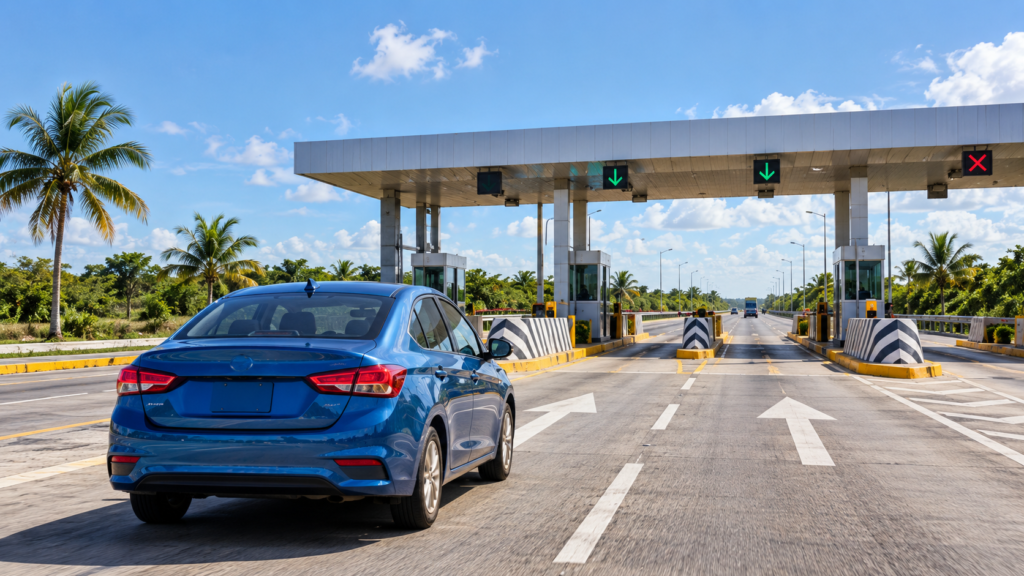
Renting a car in Cancun gives you the freedom to explore beyond the Hotel Zone, but some longer routes may include a choice between a free highway and a toll road.
For visitors unfamiliar with Mexican roads, that can raise several questions. Do you need cash? Can you use a credit card? Is a toll tag included with the rental car? Are the tolls already covered by the rental price?
The answers depend on the highway and toll operator, so it is worth checking your route before leaving. This guide explains how toll roads near Cancun work and what to prepare for a drive through Quintana Roo and Yucatan.
Are There Toll Roads Between Cancun, Playa del Carmen and Tulum?
The main coastal route connecting Cancun, Puerto Morelos, Playa del Carmen and Tulum is generally used as a regular federal highway rather than a traditional toll route.
That means a typical drive south along the Riviera Maya does not automatically require a toll payment. However, road conditions, construction and traffic patterns can change, so navigation should still be checked on the day of travel.
Toll roads become more relevant when you drive inland or west toward places such as Valladolid, Chichen Itza or Merida. Depending on the destination, your navigation app may offer both a free road and a toll-road alternative.
Do not assume that the fastest route is free. Review the complete route before you begin driving and look for labels such as “tolls,” “cuota” or “180D.”
What Do “Cuota” and “Libre” Mean?
Mexican road signs commonly use two words to distinguish highway options:
- Cuota means a toll road.
- Libre means a road without toll charges.
A cuota road may offer a more direct journey, controlled access or fewer stops, but it will add toll costs to the trip. A libre road can reduce expenses, although it may pass through more towns, intersections and lower-speed areas.
Neither option is automatically right for every traveler. The better choice depends on your schedule, daylight, destination and comfort level.
If you are planning a same-day trip to Chichen Itza, for example, saving time may be more valuable than avoiding the tolls. If you have no fixed arrival time and want to stop in towns along the way, a free route may suit you better.
How Do You Pay a Highway Toll in Mexico?
CAPUFE, the federal toll-road operator, distinguishes between electronic toll lanes and multimodal lanes where users without a tag pay the current rate directly to the booth attendant. Electronic tolling uses a device called a TAG, which is detected as the vehicle passes through the lane. gob.mx
When approaching a toll plaza:
- Reduce your speed and follow the overhead lane signs.
- Avoid entering a lane marked exclusively for electronic tags unless the vehicle has a compatible, active device.
- Choose a lane that accepts direct payment when you do not have a tag.
- Confirm the amount shown or requested.
- Pay and keep the receipt until the trip is complete.
Never reverse or make an abrupt lane change near the booths. If you enter the wrong lane, follow the attendant’s instructions.
Should You Carry Mexican Pesos?
Carrying Mexican pesos is the safest practical approach for a visitor using toll roads.
Electronic tags can be linked to a prepaid balance or a registered bank card, but a rental vehicle does not automatically include an active tag. CAPUFE’s current rules explain that drivers without an electronic device must pay the applicable tariff directly at a multimodal booth. gob.mx
Do not depend solely on a foreign credit card. Payment facilities can vary by road, operator, booth and current system availability.
Before leaving Cancun, carry enough pesos for the outbound and return journey, plus a reasonable backup amount. Smaller bills can make payment easier, particularly if the booth cannot provide change for a very large note.
Keep toll money separate from your security deposit and emergency funds.
How Much Do Toll Roads Cost?
There is no single toll price for the Yucatan Peninsula. The amount depends on the route, toll plaza and vehicle classification, and tariffs can change.
Check the route shortly before traveling rather than relying on an old blog post, social-media comment or screenshot. CAPUFE’s official route tools and the applicable highway operator are better references for current charges.
When calculating the trip budget, include:
- Tolls in both directions.
- Fuel.
- Parking.
- Admission tickets.
- Meals and activities.
- A small reserve for an itinerary change.
The security deposit for a rental car is separate from all these travel costs.
Does a Rental Car Include Toll Payments?
Do not assume that tolls are included in the daily rental price or unlimited-mileage benefit.
Unlimited mileage refers to the distance covered under the rental conditions. It does not mean that the rental company pays highway tolls, fuel, parking, traffic fines or admission charges.
If the vehicle has a toll device attached to the windshield, ask the rental company whether it is active, which roads accept it and how completed toll crossings will be charged. Do not remove, relocate or use an electronic device without understanding its conditions.
At Roady, the vehicle may circulate within Quintana Roo and Yucatan under the company’s published driving-area policy. Written authorization is required before traveling to other states. This is a Roady contractual policy, not a general Mexican traffic rule. Roady
Free Road or Toll Road: Which Should You Choose?
Start with your actual itinerary.
A toll road may be useful when:
- You have a timed entrance or reservation.
- You want a more direct inland route.
- You prefer to reduce the number of town crossings.
- You need to return before dark.
A free road may be suitable when:
- Your schedule is flexible.
- You want to stop in towns along the route.
- You are comfortable with lower speeds and local traffic.
- Reducing trip costs matters more than saving time.
Compare the complete routes, not just their distance. A shorter route is not always faster, and an estimated arrival time can change with construction, weather or traffic.
Download an offline map before leaving, but continue following road signs. If your navigation app suggests an unfamiliar shortcut or unpaved road, stay on an established route unless you have confirmed the alternative.
What Should You Do if You Cannot Pay?
Do not attempt to drive through a closed barrier or follow another vehicle too closely.
Remain calm and speak with the toll attendant. Explain which payment methods you have and follow the instructions given at that plaza.
Planning ahead is the best way to avoid this situation. Check whether your route contains tolls, carry pesos and confirm whether your rental vehicle has an authorized electronic tag.
Save Roady’s assistance number before departure. The rental team can clarify vehicle-related questions, although toll payment and lane operation are controlled by the highway operator.
Plan the Route Before You Leave Cancun
Toll roads can make certain trips through Yucatan more direct, but they are only one part of the journey. Check the route, estimate the round-trip cost, carry Mexican pesos and leave enough time to reach your destination during daylight.
Most importantly, distinguish public road rules from your rental agreement. Toll charges and payment procedures come from highway operators, while permitted travel areas, vehicle use and assistance are governed by your Roady contract.
If you are planning a drive from Cancun to Valladolid, Chichen Itza, Merida or another destination, contact Roady Car Rental with your dates, group size and route. The team can help you choose a suitable vehicle and review the rental conditions before you book.
Information verified on October 5, 2026, using CAPUFE’s current tele-toll guidance, the IAVE portal and Roady’s rental policies.